No documents to file
US and Canadian numbers need no identity or address paperwork on the carrier routes we sell. You can have a working line the day the company exists.
A US or Canadian number that answers with your own greeting, routes to the right person, and hands the ones nobody can take to an AI assistant that actually knows what you do. No handset, no contract, no installer.
The phone system itself is free. You pay for the number, and for the minutes you use.
Incoming calls are included while the number is active. You top the balance up when you want to; nothing bills you automatically for usage you did not authorise.
A new company needs a number on the website, on the incorporation paperwork, and on the payment processor’s form. What it does not need is a phone contract, a per-seat licence, or a sales call to get one.
US and Canadian numbers need no identity or address paperwork on the carrier routes we sell. You can have a working line the day the company exists.
Add every founder, every contractor and every future hire as an extension. The system costs the same with one person on it as with twenty.
One number, month to month or annually. Usage comes out of a balance you topped up on purpose, so there is no bill to be surprised by.
The two places a three-person company sounds like a three-person company are the greeting and the calls nobody picks up. Both are solved here, and neither costs extra.
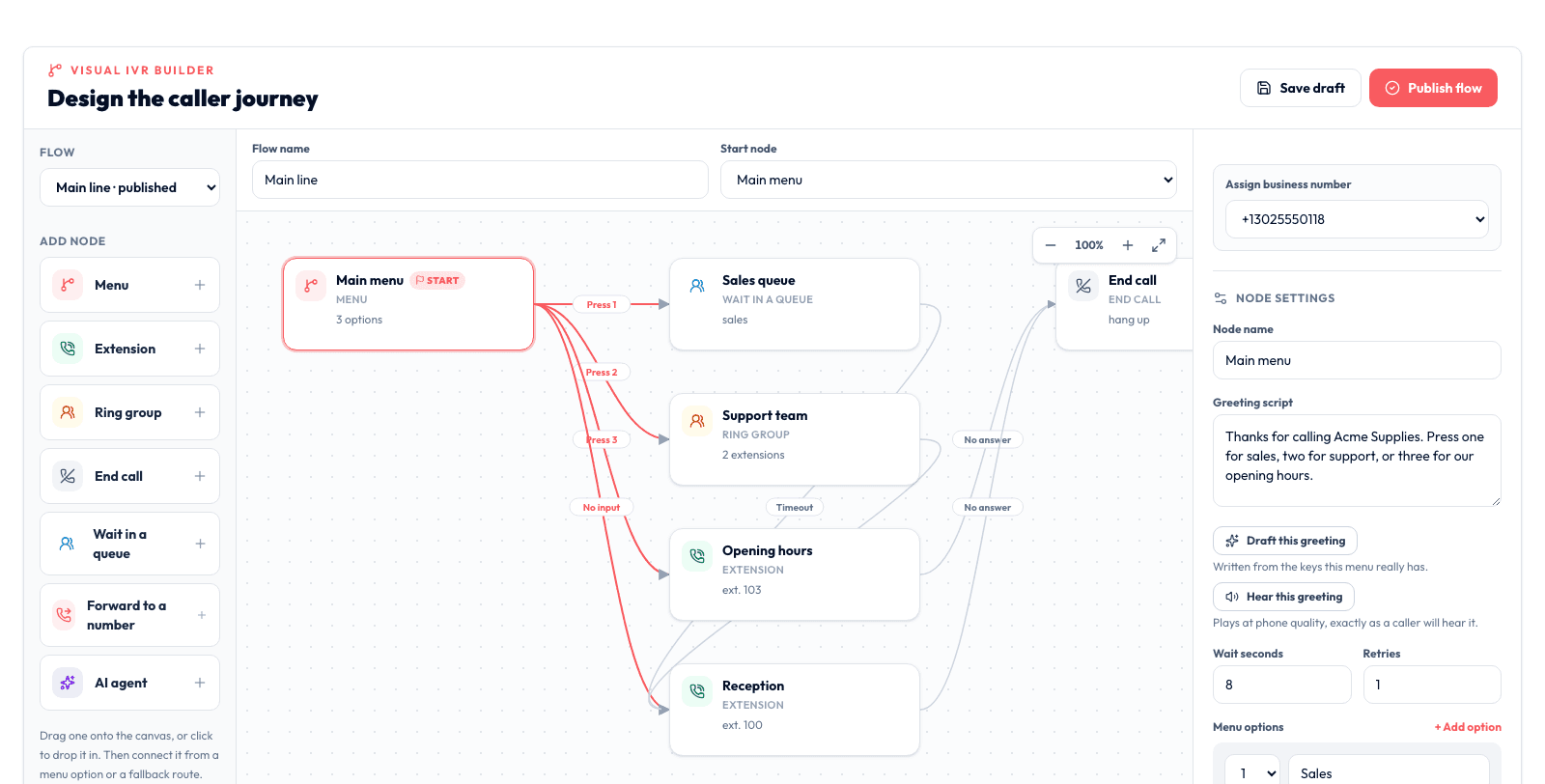
Ask the builder to draft the greeting and it writes one from the menu you actually built — the real options, on the keys they are really on. A greeting that says “press two for billing” while two goes to sales is worse than no greeting, and that is the mistake writing it by hand produces.
The greeting is read aloud by a speech model directed to sound like a receptionist rather than a narrator, and you can hear it at phone quality before you publish — exactly what a caller gets, down to the 8 kHz.
Drop an AI agent into the flow, tell it what your company does, and it takes the calls that would otherwise ring out. It hands over to a person the moment somebody asks for one — or asks about money, law, or an emergency.
A visual builder with the pieces a phone tree is made of. Drag them onto a canvas, connect them, and every route a caller can take is a line you can see.
Press 1 for sales, 2 for support. Set the keys, the wait, and where an unanswered key goes.
Give each person a number that reaches them in the browser or the app, wherever they are.
Ring the whole team in order until somebody picks up, with a fallback when nobody does.
Send a call to an ordinary mobile, so the line works before anybody has installed anything.
Hold callers in order with hold music when everyone is busy, instead of dropping them.
Send and receive texts on the same number, from the same console.
If your company was formed in the United States through Stripe Atlas, your first number is $29.73 for a year instead of $59.45 — a saving of $29.72.
RoamGo is not affiliated with Stripe or Stripe Atlas. We check applications by hand, which is why there is no code to enter and nothing to redeem here.
Two required fields. We reply with a discounted checkout link, usually within one business day.
Two prices and a balance. The phone system is not one of them.
| Monthly | $6.95 / month |
| Twelve months, paid monthlyFor comparison | $83.40 |
| Annual | $59.45 / year |
| Annual, Stripe Atlas | $29.73 / year |
Available in Canada and United States. Incoming calls are included while the subscription is active.
| United States | $0.02 / min |
| Canada | $0.02 / min |
| United Kingdom | $0.02 / min |
| India | $0.07 / min |
| Germany | $0.04 / min |
| Mexico | $0.02 / min |
Rates are per destination, not per country you are calling from, and mobile and landline differ. The dialer shows the rate for a specific number before the call connects.
Every destination and ratePick a number, draw the flow, publish it. The builder is in your account and the phone system costs nothing to try.